
'We have to up our vigil everywhere, all along the LAC -- winter, summer or spring.'

India and China on Wednesday signed in all nine agreements, including the Border Defence Cooperation Agreement and one on strengthening cooperation on trans-border rivers, after restricted and delegation-level talks that lasted over two hours as Prime Minister Manmohan Singh and Premier Li Keqiang met for the second time this year for talks which the Indian leader described as "fruitful and productive".

Sticking to its stand that McMahon Line on India-China boundary is "illegal", China on Monday said it is ready to work with India to resolve the vexed border issue at an early date through "friendly consultations" to create more favourable conditions for bilateral ties.
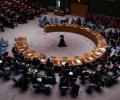
India abstained from a procedural vote taken in the United Nations Security Council to call for a rare special emergency session of the UN General Assembly on Russia's aggression against Ukraine, even as New Delhi welcomed Moscow and Kyiv's decision to hold talks at the Belarus border.

'Why wouldn't so strategically-minded an adversary, such as China, not militarily exploit to the maximum Indian timidity, stupidity, and cupidity all along the LAC and legitimate, as it has done so often in the past, the fait accompli of incremental territorial grabs which, by the way, is its strategy and policy as implemented on the ground?'
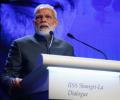
"No other relationship of India has as many layers as our relations with China. We are the world's two most populous countries and among the fastest growing major economies. Our cooperation is expanding," he said.
On the eve of high level talks between Prime Minister Manmohan Singh and his Chinese counterpart Li Keqiang in Beijing, the border issue and differing perception of India and China over the border areas they hold is dominating the relationship.

According to official sources, the primary objective of Wei's visit is to deliberate with Indian defence establishment on implementation of decisions taken by Modi and Xi in their informal summit in Wuhan in April.

'The immediate attempt by China is to get its way and gain territory through small steps without having a full-scale war.'

Just like China wants Trump to lose the US presidential poll, it may want Modi to lose the Lok Sabha polls. So months before the 2024 elections, China may take possession of an important area, say one of the Char Dhams, warns Sanjeev Nayyar.

Wary of being identified, some said they had been reassured by their friends but were still apprehensive for themselves and their families. Adding to their anxiety was news of protests.

The readouts by the Indian and Chinese sides on the meeting on Monday between External Affairs Minister Sushma Swaraj and her Chinese counterpart Wang Yi in Moscow bring out that divergences are crowding into the centrestage of their relationship, says Ambassador M K Bhadrakumar.
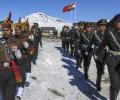
Opposition parties on Tuesday questioned the "silence" of Prime Minister Narendra Modi and Defence Minister Rajnath Singh on the violent clash between Indian and Chinese troops in eastern Ladakh and asked them to take the nation into confidence on the matter, while the ruling Bharatiya Janata Party asserted that India's borders will remain intact under Modi's leadership.

'Tibet remains a prickly issue between the giant Asian nations. China still claims more than 80,000 sq kilometres of Indian territory in the Northeast. Why? Just because Beijing refuses to acknowledge the McMahon line which separates India and Tibet, and this, simply because the 1914 Agreement delineating the border was signed by the then government of independent Tibet with India's then foreign secretary (Sir Henry McMahon),' says Claude Arpi.

Under the India-China agreement on the disengagement process in eastern Ladakh, the Chinese army will pull back its troops to east of Finger 8 areas in the northern bank of Pangong lake, Defence Minister Rajnath Singh said in Parliament on Thursday, in what is seen as a significant step to dial down tensions in the key face-off site.

'The border stand-off and the uncertainties that come with it should be a wake-up call on what makes for real rather than illusory power,' observes T N Ninan.

'Modi and Xi can solve the India-China border problem in a single sitting by keeping the big picture before them, by sweeping away the cobwebs of the past, and by mustering a statesman-like spirit and a long range vision,' says B S Raghavan, the distinguished civil servant.

China has asserted that it had never waged a war to occupy 'an inch of land of other countries', days after Bharatiya Janata Party's prime ministerial candidate Narendra Modi slammed the Communist giant for its "expansionist mindset".

'This is potentially escalatory, as China does not believe that India has any basis for interfering in a bilateral dispute between China and one of its neighbours.'

'If you behave like a nail, the adversary will behave like a hammer.'

From the standoff with China to the government's response to the farmers' protest, Defence Minister Rajnath Singh holds a freewheeling talk.

'It is because of the bravery of Colonel Santosh Babu and his men that we have not seen a violent escalation anywhere else along the LAC.'

'One must remember that a dragon has a forked tongue,' warns Vivek Gumaste.

While OnePlus 8 and 8 Pro were launched in April, the devices were not brought into the Indian market given the lockdown.
'India's challenge is status quo ante. China's challenge is a face-saving exit'

Indians at large harbour a notion that their country is cherrypicking out of the American basket of goodies, but the policymakers in Delhi and the political leadership are well aware that it can only be a pipe dream since a military alliance with a superpower is a profound irrevocable commitment, observes Ambassador M K Bhadrakumar.

'The adversary will always exploit India's anti-national elements.'

India is committed to finding an 'early settlement' to the vexed boundary issue: Swaraj

'There will be some issues of contention, especially on H1B visa and on trade policy.'
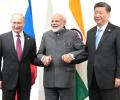
For the first time since the standoff between Indian and Chinese troops along the Line of Actual Control (LAC) in eastern Ladakh, Prime Minister Narendra Modi and Chinese President Xi Jinping are expected to come face-to-face virtually at the BRICS (Brazil-Russia-India-China-South Africa) annual summit to be held on November 17.
'They cannot use firearms.' 'They have to be restrained.' 'It is a game of patience and chess board moves.' 'It is not like India and Pakistan where bullets get fired and people get killed.'

There is no conceivable reason for any big power to put road blocks on the path of an India-Pakistan normalisation process, asserts Ambassador M K Bhadrakumar.
'We will not accept these misadventures by the Chinese.'

We strongly urge India to take practical steps to correct its mistake, Wu said.

'Both have a very nationalistic view of foreign policy.' 'They think they are shrewd and clever diplomats.'

Modi, who is undertaking his first visit to China as prime minister, will reach the ancient city of Xi'an, the home town of President Xi Jinping, for a summit meeting, an unusual departure from normal protocol and seen as a reciprocal gesture by the Chinese leader who was hosted by Modi in Ahmedabad when he visited India in September last year.

Narrowing of differences on competing territorial claims along the un-demarcated LAC might take weeks, if not months, of hard-nosed negotiations. Without some give and take on both sides, the impasse will be hard to resolve, observes Virendra Kapoor.

'Once positions are hardened and troops start building defences, it is difficult for soldiers to step back.'
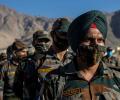
'China is mindful of the fact that it is not confronting the Indian Army of 1962. But the sabre rattling will continue.'

Arpi deserves to be complimented for the commitment and hard work that have gone into this production. The frustrations of seeking reliable documentation from the catacombs of the Indian bureaucracy did not deter him from going after the best information available, and the result is one that he can take much satisfaction in. Ambassador Prabhat P Shukla, Member Advisory Council, Vivekananda International Foundation, reviews Claude Arpi's The End of an Era: India Exits Tibet.
